Efficient Patient Management: Connected, Transparent, and Secure

Manage patient flows across locations and departments in real time—using integrated Salesforce processes and Tableau analytics, operated with confidence on STACKIT within the European legal framework.
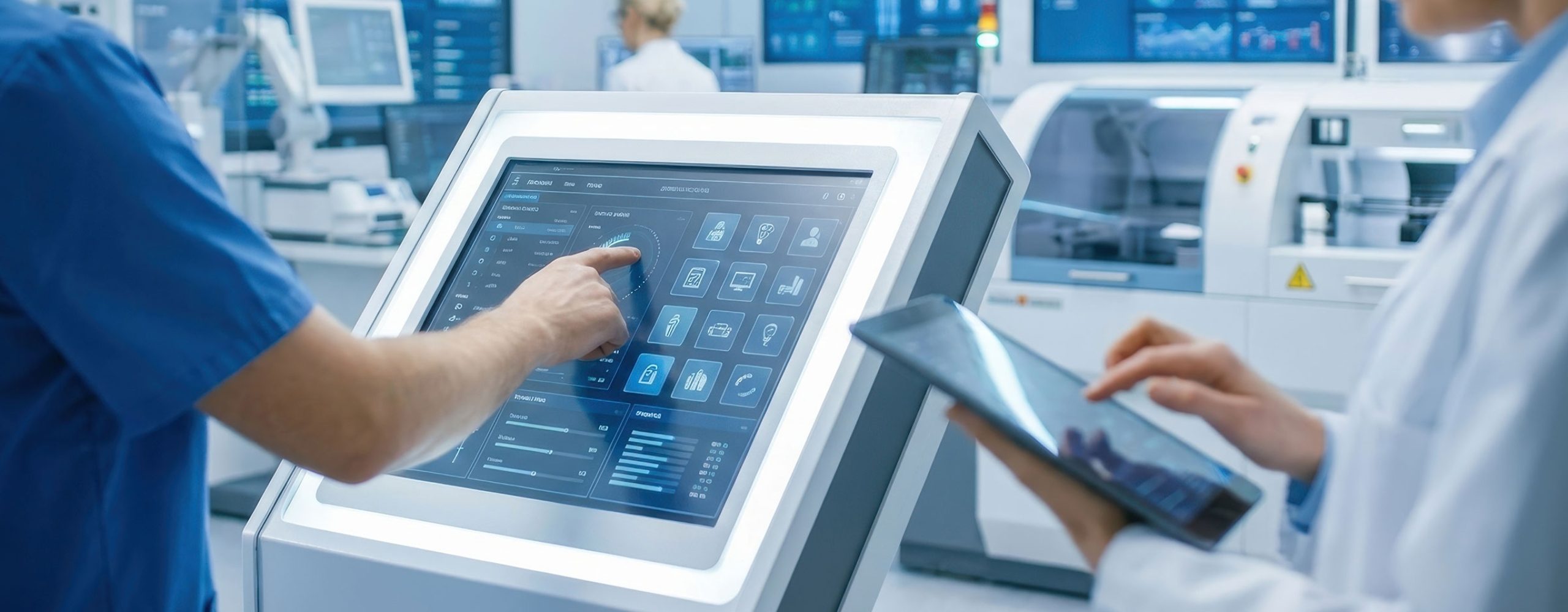
Medical staff using a touchscreen terminal and tablet for efficient patient management in a hospital setting.

Challenge: Fragmented Systems and Lacking Transparency in Capacity Utilization

In many hospitals and healthcare facilities, siloed systems prevent proactive capacity management. Data on admissions, diagnostics, OR scheduling, and ICU and rehab capacities are stored in separate systems. As a result, there is no consistent overview of the facility’s current status and available resources.

System Chaos in Core Systems

HIS, PACS, and LIS data are locked away in proprietary silos, making it difficult to quickly access complete patient histories and often requiring information to be manually consolidated.

Rigid process chains

Inflexible interfaces prevent seamless patient pathways and complicate the use of modern applications—such as patient portals or mobile solutions for nursing staff—in day-to-day clinical operations.

Resource constraints in everyday hospital life

Manual data transfers between systems tie up medical staff, are prone to errors, and increase the organizational burden while workloads continue to rise.

Measurable Benefits: Higher utilization, fewer vacancies, more stable revenue

Use integrated data to strategically allocate beds, operating rooms, and teams, and to identify bottlenecks early on. This allows you to increase your facility’s efficiency while improving the predictability of your capacity planning.

  • More cases per year: By reducing “empty bed time” between discharge and re-admission, more patients can be treated each year without having to expand resources.
  • Fewer Misallocations: More precise bed allocation improves the assignment of patients to the medically appropriate care unit and increases transparency regarding occupancy and revenue impact.
  • Shorter Length of Stay: By integrating discharge management into Salesforce, follow-up care can be initiated earlier, and capacity becomes available again more quickly.
  • Fewer surgery cancellations: Improved predictability of available ICU capacity reduces cancellations of scheduled procedures and avoids costly downtime in the operating room.

Solution: Connected Health Platform on STACKIT

Rely on a Connected Health Platform that connects your existing systems and clinical processes via an API-first architecture and creates a unified database. The MuleSoft Accelerator for Healthcare provides HL7v2 and FHIR R4 assets to integrate relevant data from HIS/EHR and other specialized systems in a standardized manner into a cross-system control and interaction layer and to establish complex point-to-point interfaces.

On this basis, treatment processes are digitally supported, and relevant data is made centrally available. A Tableau consolidates occupancy, treatment, and surgical data and presents it clearly in dashboards. Supplemented by historical trends, developments can be identified early on—for example, during seasonal spikes such as flu outbreaks or rising patient volumes.

Depending on the target architecture, integration and analytics components can be seamlessly operated on STACKIT. Salesforce Health Cloud is provided as a cloud service in the designated regions. This enables the secure processing of sensitive health data while ensuring high transparency across all relevant metrics.

Competitive Advantage: Proactive Management Instead of Reacting in Crisis Mode

Actively leverage clinical data to manage your facility and sustainably improve transparency and decision-making capabilities in day-to-day operations.

Real-time transparency across locations

Consolidated data provides a centralized overview of bed capacity, operating room utilization, and intensive care resources, reducing the need for coordination between departments.
Predictive Planning

The combination of current data and historical trends supports early detection of bottlenecks and targeted management of measures during ongoing operations.

Stable Operational Processes

The platform remains reliable even under high load and supports continuous and predictable capacity management.

Foundation: Integrated integration layer on STACKIT

The solution is based on an integration and analytics platform specifically designed to handle sensitive healthcare data within the European legal framework and ensure secure data processing.

Digital representation of a cloud infrastructure with illuminated, networked data centers (towers) on a blue board, symbolic of big data and hyperscaler environments.

Self-Contained Integration Layer

The MuleSoft Runtime runs on STACKIT to centrally orchestrate HL7 and FHIR interfaces and make data flows transparent and controllable.

Close-up of a magnifying glass enlarging a candlestick chart on a digital screen. Financial analysis, trading, and stock market data.

Centralized Data Provision for Analyses

Relevant treatment and capacity data are consolidated and made available for Tableau dashboards to enable informed decisions based on up-to-date information.

STACKIT EU security

Secure Operations Within the European Legal Framework

The processing of sensitive patient data takes place within a clearly defined legal framework and supports compliance with regulatory requirements in the healthcare sector.

Frequently Asked Questions (FAQ)

Ready for more efficient patient management and more stable capacity utilization at your facility?